
The cloud’s transformative power offers unparalleled scalability and flexibility, but this convenience comes with inherent security risks. Understanding and implementing robust cloud security best practices is no longer optional; it’s a critical necessity for organizations of all sizes. This guide delves into the core principles, essential strategies, and practical considerations necessary to safeguard your valuable data and applications in the dynamic cloud environment.
From securing access and managing identities to implementing robust data protection measures and establishing a strong security posture, we’ll explore a comprehensive range of topics. We’ll also examine the shared responsibility model, compliance requirements, and the crucial role of continuous monitoring and incident response. By understanding these elements, you can build a resilient and secure foundation for your cloud operations.
Defining Cloud Security Best Practices
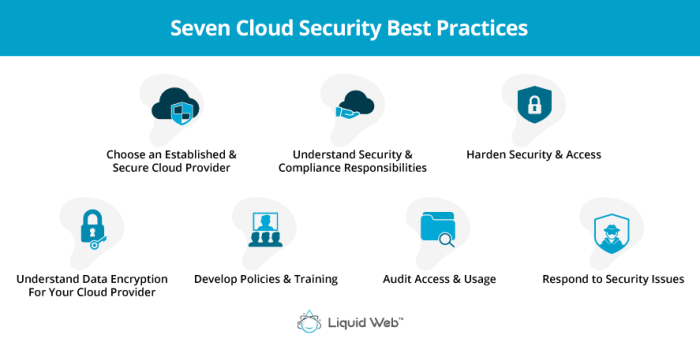
Cloud security best practices are a set of guidelines and procedures designed to protect data, applications, and infrastructure hosted in the cloud. These practices aim to mitigate risks and ensure the confidentiality, integrity, and availability of cloud resources, adapting traditional security principles to the unique challenges and opportunities of the cloud environment. Effective cloud security requires a proactive and multi-layered approach, involving both technical controls and organizational policies.
Core Principles of Cloud Security
The core principles of cloud security build upon established security frameworks but are tailored to the dynamic nature of cloud computing. These principles emphasize shared responsibility, data security, identity and access management, and continuous monitoring. A strong understanding of these principles is essential for implementing effective security measures. Key aspects include understanding the shared responsibility model with the cloud provider, proactively managing vulnerabilities, and consistently monitoring for threats.
Regular security assessments and penetration testing are crucial to identify weaknesses before malicious actors exploit them.
The CIA Triad in the Cloud Context
The CIA triad—Confidentiality, Integrity, and Availability—remains fundamental to cloud security. However, the cloud environment presents unique challenges to maintaining each of these tenets.
Confidentiality in the cloud focuses on protecting sensitive data from unauthorized access. This involves encryption both in transit and at rest, access control lists (ACLs) to restrict access based on roles and permissions, and data loss prevention (DLP) measures to prevent sensitive information from leaving the cloud environment. For example, encrypting databases at rest prevents unauthorized access even if the database server is compromised.
Integrity ensures that data remains accurate and unaltered. This is achieved through techniques like hashing and digital signatures to verify data authenticity, version control systems to track changes, and intrusion detection/prevention systems (IDS/IPS) to detect and prevent unauthorized modifications. Using checksums to verify data integrity after transmission is a good example.
Availability means ensuring that authorized users can access cloud resources and data when needed. This involves implementing redundancy and failover mechanisms, load balancing to distribute traffic, disaster recovery planning, and robust infrastructure design. For instance, employing geographically dispersed data centers ensures business continuity in case of regional outages.
Common Cloud Security Threats and Vulnerabilities
Cloud environments, while offering numerous advantages, are also susceptible to a range of security threats. These threats can stem from both internal and external sources, targeting various aspects of the cloud infrastructure and applications.
Misconfigurations: Incorrectly configured cloud services, such as improperly set access controls or insecure network settings, represent a significant vulnerability. For example, leaving an S3 bucket publicly accessible can lead to data breaches.
Insider threats: Malicious or negligent employees with access to cloud resources can pose a serious risk. Strong access controls and regular security awareness training are crucial mitigations.
Data breaches: Unauthorized access to sensitive data, often due to vulnerabilities or misconfigurations, can have devastating consequences. Encryption, access controls, and regular security audits are essential safeguards.
DDoS attacks: Distributed denial-of-service attacks can overwhelm cloud resources, making them unavailable to legitimate users. Employing DDoS mitigation services is a key preventative measure.
Malware and viruses: Cloud-based applications and systems can be infected with malware, compromising data and system integrity. Regular patching, antivirus software, and robust security monitoring are necessary.
Comparison of Cloud Security Models
| Security Model | Responsibility for Security | Focus | Example Implementation |
|---|---|---|---|
| Shared Responsibility | Shared between cloud provider and customer | Dividing security tasks based on control layers | Provider secures infrastructure; customer secures data and applications. |
| Zero Trust | Verify every access request, regardless of location | “Never trust, always verify” approach | Multi-factor authentication, micro-segmentation, and continuous monitoring. |
Access Management and Identity
Securing access to cloud resources is paramount. Robust access management and identity systems are the foundation of a strong cloud security posture, preventing unauthorized access and data breaches. Effective strategies in this area minimize risk and ensure compliance with various regulations.Strong authentication and authorization are critical for controlling who can access cloud resources and what actions they can perform.
Weak authentication methods leave systems vulnerable to unauthorized access, while poorly designed authorization systems can grant excessive privileges, increasing the potential impact of a security breach.
Strong Authentication and Authorization Mechanisms
Implementing multi-factor authentication (MFA) is a crucial step. MFA requires users to provide multiple forms of authentication, such as a password and a one-time code from a mobile app, significantly increasing the difficulty for attackers to gain access. Beyond MFA, regularly rotating passwords and utilizing strong, unique passwords for each account is vital. Furthermore, leveraging techniques like password managers can help individuals manage complex passwords effectively without compromising security.
Authorization mechanisms, such as role-based access control (RBAC), ensure that users only have access to the resources and functions necessary for their roles.
Access Control Models
Several access control models exist, each with its strengths and weaknesses. Role-Based Access Control (RBAC) assigns permissions based on a user’s role within an organization. For example, a database administrator would have different permissions than a regular employee. Attribute-Based Access Control (ABAC) is more granular, assigning permissions based on attributes of the user, the resource, and the environment.
This allows for fine-grained control and dynamic policy adjustments based on context. For instance, an ABAC system could grant access to a sensitive document only to employees located within a specific geographical region during business hours.
Managing User Identities and Credentials
Effective identity and access management (IAM) involves several best practices. Regularly auditing user accounts to identify inactive or compromised accounts is essential. Implementing a process for provisioning and de-provisioning accounts quickly and efficiently ensures that access is granted only when needed and revoked promptly upon termination or role changes. Utilizing a centralized IAM system provides a single point of control for managing user identities and credentials across multiple cloud services, simplifying administration and improving security.
Password management policies, including password complexity requirements and regular password changes, are critical.
Minimizing Privilege Access
The principle of least privilege dictates that users should only have the minimum necessary access rights to perform their tasks. This significantly reduces the potential damage from a compromised account. Regularly reviewing and adjusting user permissions to ensure they align with current job responsibilities is vital. Employing techniques like just-in-time access, where permissions are granted only when needed for a specific task and then revoked afterward, minimizes the window of vulnerability.
Implementing strong monitoring and alerting systems can detect and respond quickly to suspicious activity, helping to mitigate the impact of any security breaches.
Securing your cloud environment requires a multifaceted approach, encompassing proactive measures, reactive strategies, and a commitment to continuous improvement. By diligently implementing the best practices Artikeld in this guide – from robust access controls and data encryption to vigilant monitoring and incident response planning – organizations can significantly mitigate risks and protect their valuable assets. Remember that cloud security is an ongoing journey, not a destination; regular review and adaptation are key to maintaining a strong security posture in the ever-evolving cloud landscape.
Common Queries
What is the shared responsibility model in cloud security?
The shared responsibility model dictates that the cloud provider is responsible for the security
-of* the cloud (infrastructure), while the customer is responsible for security
-in* the cloud (data and applications). The specific responsibilities vary depending on the service model (IaaS, PaaS, SaaS).
How often should I perform vulnerability scans?
Regular vulnerability scans should be conducted frequently, ideally on a continuous basis or at least monthly, depending on your risk tolerance and the sensitivity of your data. The frequency should also align with industry best practices and regulatory requirements.
What are some common cloud security threats?
Common threats include data breaches, denial-of-service attacks, malware infections, insider threats, misconfigurations, and lack of appropriate access controls.
How can I ensure compliance with regulations like GDPR and HIPAA?
Compliance requires a multi-pronged approach including implementing appropriate security controls, documenting processes, conducting regular audits, and ensuring your cloud provider meets the relevant standards. Engage legal counsel to ensure full compliance.